
Let's Trade
It's time to bring back bartering in a real way

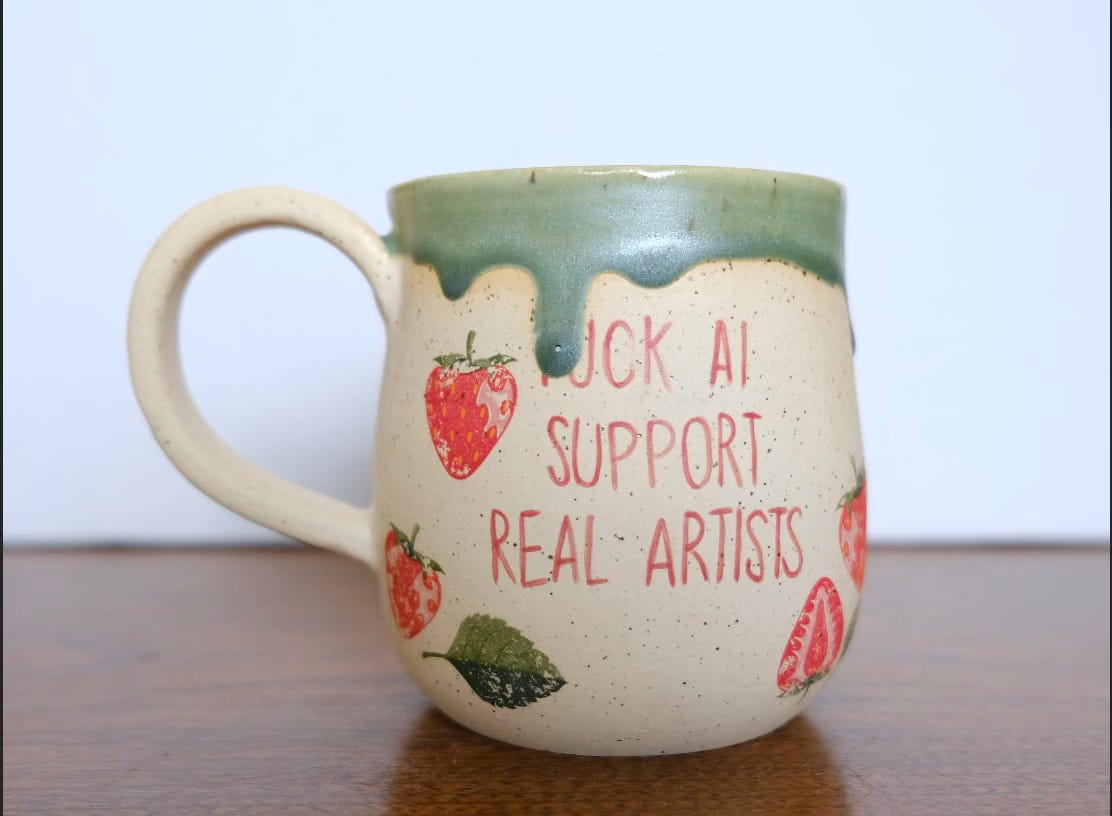
Something I’ve noticed when it comes to small businesses utilizing AI to make the most horrendous graphics you’ve ever seen in your life is the common excuses they give when trying to justify it. People have responded to negative feedback with “I don’t have the skills to make a poster”—which I have a hard time believing because you obviously made posters pre-AI—and “I don’t have the money to hire a graphic designer”. The latter, okay, I’ll give you the benefit of the doubt, but again, posters and graphics were being made before everyone had access to AI so there's obviously some sort of solution out there. While it’s hard to consider hiring someone when budgets are lean, I believe we’d all benefit from considering a viable alternative—bartering.
When I stumbled upon a post of a small business apologizing for their use of AI, this business being one who considers a foundational part of its values being eco-friendly, I actually admired them admitting to their misstep. No matter what your business is, using AI for your graphics is going to lose you respect these days and acknowledging that was the best path forward for them. What they chose to do in the wake of this criticism is reach out directly to their community. They mentioned that the budget is lean, so hiring a graphic designer isn’t really feasible, but they’re willing to trade for some graphics work. Problem solving in the best possible way. Two parties coming together and creating a mutually beneficial circumstance.
My community pottery studio is a small business, woman owned, also on a lean budget as it is still in its early years. The studio is busy enough that one person cannot manage everything on their own but not quite busy enough to have a team of regular paid staff. Most of the money being made goes right back into funding growth—plus, ceramics is an expensive endeavour. Conveniently, the owner is a big lover of trades. I work for the studio doing some photography, assisting at markets and workshops, occasional graphic design work, and practical help around the studio when needed. Other people do tasks like processing the reclaim clay, trimming and glazing workshop pieces, helping with admin work, loading and unloading the kiln etc. In trade for putting in a few hours of work during the week we are given studio access and kiln use. We gain the use of a ceramics studio, her the benefits of a staff. If I were to be paid in actual dollars for my work they’d likely just go towards paying for studio time anyways, so why even exchange money in the first place? Bartering is the perfect solution for everyone involved.
One important lesson I’ve learned about business is when you can hire someone to do a task in 5 minutes, that would otherwise take you 3 hours, it’s worth it. But when your dollars are tight, you have to get creative. I’m mostly against working for exposure alone, its often a way for larger companies and businesses to exploit people, but if we can voluntarily work for soap, classes, workshops, tickets, products etc. then we’re gaining something much more beneficial. Someone new to the graphic design scene does benefit from exposure, but they still need to get paid. Rather than paying in dollars, maybe they are paid in artisan soap. Maybe it won’t help pay the electricity bill, but if it’s a product you were already hoping to purchase, your money can now be spent elsewhere. Perhaps getting tickets to a local festival isn’t going to help pay down my mortgage, but if the task took 30 minutes to complete and I didn’t outlay any cash of my own, I now get to see an event I’d want to go to anyways basically for free! Not a bad way to spend 30 minutes of life.
People have such a bevy of skills to trade outside of just their career skills so bartering can be done with so many different people. When I consider the skills I have to offer, the list is actually fairly substantial. Ceramics—making, but also if times got desperate, I could teach someone something. I have a decent sized vegetable garden and start my own seedlings, I can do basic graphic design work, I am an amateur photographer, I already do social media part time for another business. I could watch your pets while you’re away, care for your houseplants. The specifics within these categories are endless! I could take photos at a birthday party or do some basic product photography, write copy for a social media page or email newsletter, create flyers or sticker designs, fill a basket with garden fresh tomatoes and cucumbers and beans, grow you seedlings at the beginning of the gardening season, make a custom ceramic mug or set of Christmas ornaments. I could easily exchange any one of these things for something else that I can’t, or don’t want to, do.


The real beauty of a bartering system is the perceived value from the person you are trading with. Take ceramics for instance; I do ceramics because I genuinely love it, I decided to sell ceramics to raise money for charities but a small part is so my house isn’t filled with ceramics. (I feared eventually Phil would sit me down for a serious conversation about how many ceramics pieces found their way into our house.) The actual monetary value of a piece of pottery is somewhat fluid. The largest portion of the cost is time, but sometimes it’s worth considering I’d be making certain things anyways because I simply love pottery.
A friend and I recently exchanged a set of ceramic bookends for a crochet scarf—the bookends took for-ev-er and I ruined 3 sets along the way. It took a lot of time and extra product costs so dollar for dollar, hour for hour, it might not really be exactly equal but my scarf is completely gorgeous! I’m never going to bother learning to crochet, so the deal was still absolutely worth it. For her the value in the pottery was similar to my own. It would cost more money and more time for her to make the bookends than it did to crochet the scarf, and she already crochets regularly. She doesn’t have the supplies, the skills, or perhaps even the interest in tackling a ceramics project just like I don’t have the supplies, the skills, or the interest in learning crochet. It was easier, and more enjoyable, for both of us to simply engage in our already established interests.
Way back in 2006 Canadian blogger Kyle MacDonald gained famed by trading a single red paperclip and working his way up to a two story house. It took him 14 trades to get there, making trades like a fish-shaped pen for a hand-sculpted doorknob, a recording contract for one year of free rent in Phoenix, Arizona. The amazing thing about analyzing these trades is how the cost to the trader was so often lower than the perceived value of the trade. Some of these items people were just looking to offload, maybe even ignoring the actual dollar value. Other things were very valuable but not costly to the one offering it. If you own the recording studio, a year recording contract costs you very little compared to the dollar value it would cost someone else to pay for those services. If you own a house in Arizona then giving up a year of rent might actually cost very little to you if the house is already mortgage free, but someone living rent free for that long could be life changing for them. One trade item was an all-expenses-paid trip to Yahk, British Columbia—if that trip was initially a prize then it literally costed the trader nothing, and if they don’t travel well then getting rid of it for something of more value (A snowmobile) ends up being a pretty great deal. Could they have sold it? Probably. But maybe they would’ve used the money to buy a snowmobile.. why not cut out the middle man if the opportunity presents itself?
In life certain things will always require actual monies—your cable company and phone provider aren’t going to be willing to barter with you, they want cash (so to speak). Other things are a lot more flexible if you are able to find someone who also needs what you have to offer. By reducing expenses in other flexible categories like groceries, gifts, or services, you’re able to conserve cashflow for the things that demand it and ease the burden of overall living costs. Making a deal with a local farm for their weekly CSA boxes for a bit of social media work is helpful to the farmers (who probably want nothing to do with social media) and helpful to you because you now get farm fresh produce! Trading my tech skills with my community pottery studio has allowed me to grow my little pottery business without the pressures of buying a kiln (carrying a price tag of $5000+) or the steep learning curve of trying to navigate the ins and outs of starting a business all on my own.


As a business it’s also a fantastic way to fill empty appointment slots or offload old or overstock items. When I finish a ceramics collection I want to clear out old pieces before introducing new ones so my collections remain cohesive. The older pieces don’t lose their inherent value simply because they don’t match the new collection, I still spent the same amount of time and effort on each piece. After a while these pieces will be discounted simply to clear them out. Alternatively, if I’m able to take something I already want gone and trade it for an equivalent want or need, in a way I’ve been able to keep its value and still get “paid”. If Thursday at 1:00pm is often an empty appointment slot, and you’re in desperate need of a flyer, trading that work for a time slot that otherwise wouldn’t be producing any income anyways is better than leaving it empty and making an ugly flyer with AI.
Historically money has existed for a long time, we can trace “money” (aka Cowrie shells) being used as far back as 120BCE, but during times of economic hardship bartering tends to be revived. In the 1930s, during the Great Depression, many people reengaged with bartering to obtain food and other necessary services. As we near closer to the 2030s, and somehow feel as though we’re in another age of economic hardship, I can’t help but think that bartering should make itself more common once again. Not only does it ease the burden of costs, but it also forces you to once again be a part of your own local community—something we could all use more of. Talk to your neighbours, talk to local businesses, at the very least drop a post on your local community Facebook group proposing a trade for services you might need.
Love this! <3